Choosing a Box to Ship a Painting
How to size a box for a painting, which box types suit which work, how box size triggers carrier fees and limits, and when to use a crate instead.
- Priced from carrier rates for your route, box size and service.
- Includes the box, packaging, both journeys and insurance.
- Rates are reviewed when you order, so the price can change.
- Subscription plan discounts are applied at checkout.
Buy a new, rigid corrugated box whose inside measures at least 4 inches more than the framed painting in length, width and depth. That leaves 2 inches of cushioning on every side. Depending on the frame, that can be a picture or mirror box, a pre-made art box with foam inserts, or a double-wall carton. Before you buy, check the box’s outside dimensions against your carrier’s size rules, because a box a few inches too big can double what you’re billed or put it past a carrier’s limit. If the packed box would cross those limits, or the work is heavy, glazed, fragile or valuable, use a crate rather than a box.
How much bigger than the painting the box should be
Measure the painting with its frame at the widest points, and measure depth from the face of the frame to the back, after taking off the hanging wire and hooks. Then add the cushioning.
The Canadian Conservation Institute’s Five Steps to Safe Shipment treats 2 inches (50 mm) of cushioning as the general guide. It rates parcel courier networks as the highest hazard for small and medium packages, says to expect drops of up to 2 m (6.5 ft), and says fragile items there may need 3 or 4 inches. Every inch of cushioning goes on both sides, so 2 inches all round makes the box 4 inches bigger than the frame in each dimension, and 4 inches all round makes it 8 inches bigger.
Depth is where most bought boxes fall short. The mirror boxes sold by moving suppliers are commonly about 4 inches deep, which leaves little room on either side of a frame 2 or 3 inches thick. A box that is right on length and width can still be too shallow, so check depth first.
The opposite mistake costs money. Empty space inside a box lets the painting slide and hit the walls, and it also makes the box bigger for no gain. Fill any extra room completely, or pick the next box down.
How box size changes what carriers charge and accept
Carriers bill a light, bulky parcel by its size. UPS’s daily rate and service guide explains the method: measure each side at its longest point, round to the nearest inch, multiply length by width by height, and divide by 139. If that dimensional weight is more than the scale weight, you pay for the dimensional weight. The same guide sets size lines that matter for paintings:
| UPS rule | When it applies to a domestic package |
|---|---|
| Additional Handling | Longest side over 48 in, second-longest over 30 in, or length plus girth over 105 in. Billed as at least 40 lb |
| Large Package Surcharge | Length plus girth over 130 in, or length over 96 in. Billed as at least 90 lb |
| Maximum size | Length 108 in, length plus girth 165 in |
| UPS Access Point location | Longest side 38 in or less, length plus girth 130 in or less, 44 lb or less. The UPS Store locations follow UPS’s larger general limits |
Girth is twice the width plus twice the height. UPS also charges Additional Handling on any package whose outer container isn’t corrugated cardboard, wood included, and on packages 1 inch or less in height that go through its irregular sorting.
The Postal Service sets its own ceiling. The Domestic Mail Manual’s physical standards cap Priority Mail and Priority Mail Express at 108 inches in length and girth combined, and commercial USPS Ground Advantage at 130 inches, with 70 pounds as the weight limit. FedEx publishes its own dimensional weight divisor and handling thresholds in its service guide. Carriers revise these figures when rates change, so check the current guide before you buy the box.
Here is what those rules do to one painting. A 30 by 40 inch canvas in a frame 1.5 inches deep, with 2 inches of cushioning all round, needs a box about 34 by 44 by 6 inches. UPS bills that as 65 pounds. Its second-longest side is over 30 inches, so Additional Handling applies. Its length plus girth is 124 inches, too big for Priority Mail, and at 44 inches long it is over the Access Point limit, so plan on a UPS Store location or a pickup. Pad the same painting with 4 inches all round and the box grows to about 38 by 48 by 10. UPS bills that as 132 pounds, it passes the Large Package line, and it is too big for any USPS service. A 16 by 20 inch canvas in a 20 by 24 by 5 inch box, by contrast, bills at 18 pounds and clears every line in the table.
The main box types and when each fits
| Box type | Fits | Watch for |
|---|---|---|
| Single corrugated carton sized to the work | Small unframed canvases, panels and prints | Thin walls on cheap cartons; no room for glass or deep frames |
| Picture or mirror box | Framed work that fits its fixed size with room for padding | Fixed depth, often about 4 in; sold mainly for moving |
| Telescoping or multi-piece box | Odd sizes between standard boxes | The overlapping joints are weaker than a one-piece box |
| Double-wall carton or box-in-box | Glass, heavy frames, longer parcel routes | Adds size, and with it billable weight |
| Pre-made art box with foam inserts | Standard sizes, repeat shipping | Check the inner space against the frame, depth included |
| Wooden crate | Large, heavy, glazed, fragile or high-value work | Built to order; large ones often move as freight |
A picture or mirror box is the most common bought option. U-Haul’s Mirror & Picture Box, for example, measures 37 by 27 by 4 inches, is rated for 65 pounds and has an ECT rating of 32. At that size it sits just under UPS’s 30-inch and 105-inch handling lines. In its answers to customer questions, U-Haul says the box is suitable for shipping.
Telescoping and four-piece boxes slide together to fit a frame between standard sizes. They solve the fit problem, but each overlap is a seam that can open if the box lands on it. Tape every joint along its full length, and treat a telescoped box as a moving box unless its maker says it is built for parcel shipping.
A double-wall carton has two layers of fluting instead of one, so it resists crushing and puncture better. The box-in-box method goes further. The wrapped painting goes in a snug inner box, and that box floats in cushioning inside a larger outer one. The conservation note above calls this a double case system. It protects glass and deep frames well, but the outer box is the one carriers measure.
When a box isn’t enough and the work needs a crate
Move to a crate when any of these is true:
- The packed box would pass the carrier’s large-package or maximum-size lines, as in the 38 by 48 inch example above.
- The frame is heavy or ornate, or a large sheet of glass sits over the work.
- The surface can’t take any pressure, such as flaking paint or thick, soft impasto.
- The painting is worth more than the parcel coverage you can buy for it.
The conservators’ note calls the crate “the first line of defence” and lists corrugated mirror boxes and triwall containers as light crating that may suit controlled networks. For commercial carriers it recommends durable crating with at least 2 inches of cushioning, built to recognized standards such as ASTM’s. Its basic plywood crate uses panels 9 to 18 mm thick. A wooden crate also costs more on parcel networks, since UPS charges Additional Handling on any non-corrugated container.
Where to get the box
A fine art shipper or crating firm builds a crate to the painting’s measurements and packs the work into it. That is the right route for anything on the crate list above.
A pack-and-ship counter sells cartons, can cut or build a box to size, and will pack the work for you. It suits framed pieces with glass or awkward sizes when you don’t want to source materials.
Buying a box yourself costs least. Moving-supply stores sell picture and mirror boxes, and packaging suppliers sell double-wall cartons and art boxes with foam inserts. It suits a small or mid-sized painting with no glass, packed by someone careful.
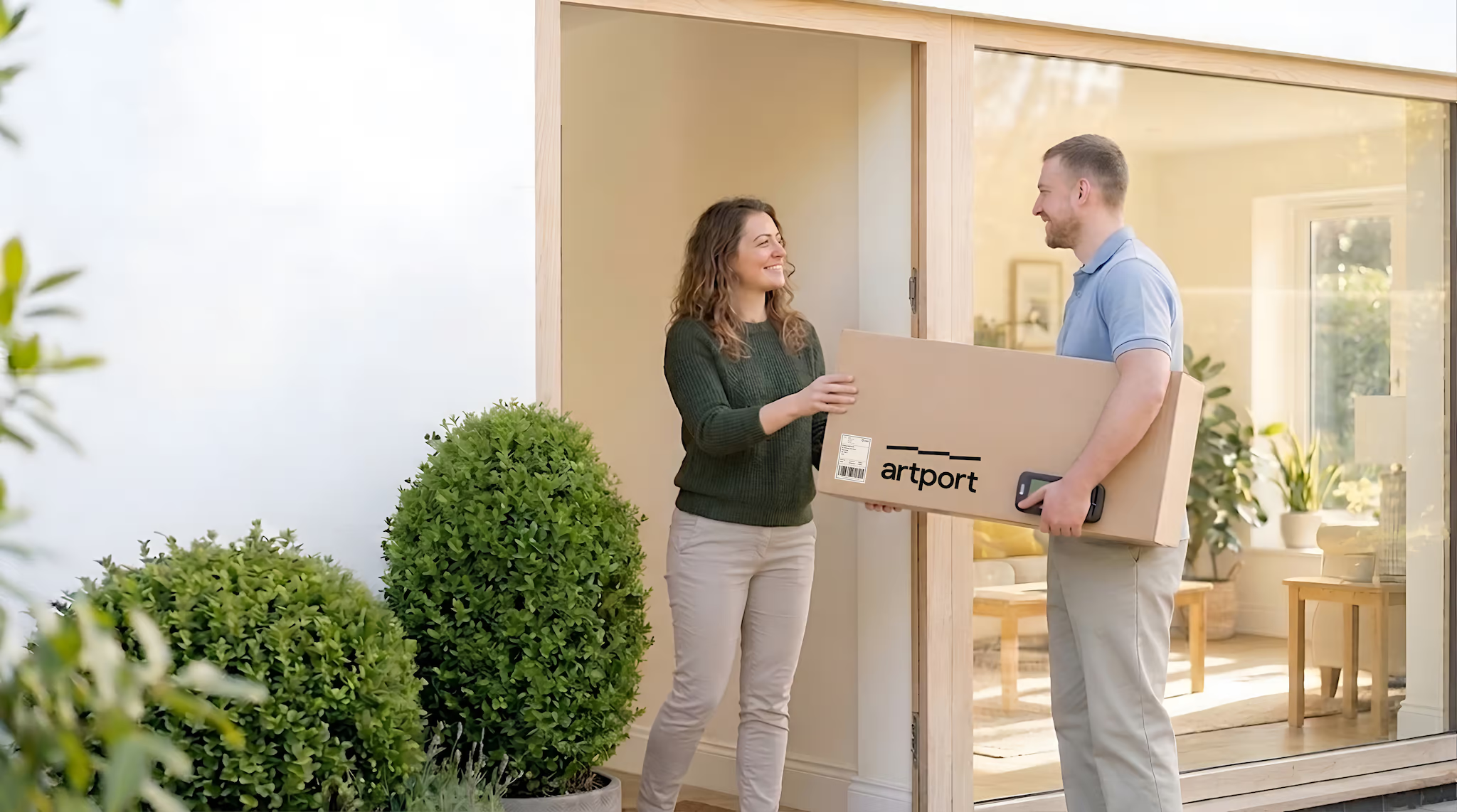
ArtPort sends an empty foam-lined box in one of three sizes as part of an insured shipment. It doesn’t sell the box on its own.
Where ArtPort fits
ArtPort’s three boxes measure 23 x 19 x 4 in, 37 x 25 x 4 in and 44 x 34 x 4 in. It suits a flat painting, framed work, print, photograph or work on paper that fits one of them, travels within the US, and is declared at $50 to $10,000. You pack the work into the box at home, then hand it to FedEx or UPS, either at a drop-off point or by booking a carrier collection. The artwork journey is insured at its declared value, and one estimate covers the box, packaging, both journeys and that insurance.
It doesn’t fit anyone who only wants to buy a box, since ArtPort doesn’t sell boxes separately. It also doesn’t fit work bigger than 44 x 34 x 4 in, frames deeper than 4 inches, or anything on the crate list above. A fine art shipper handles those. If your painting fits, measure it with its frame, pick the smallest of the three boxes that leaves room around it, and price that box for your two addresses with the estimate above.
Disclaimer: This page may contain AI-assisted content. The information is provided solely as a general guide and may not be correct, complete, or current, including, but not limited to, our full or applicable service offerings. While we strive for accuracy, no guarantee is made regarding correctness or completeness, and no expectation should be made as such.
Pick a topic from the list below to discover how ArtPort handles shipping, condition reports, insurance, pricing, and more.
ArtPort is a platform for shipping fine art. We send you a box with foam inserts sized for your artwork, you pack and photograph it, and we arrange insured delivery with a major carrier, all tracked from one account.
ArtPort is designed for artists, galleries, collectors, and art businesses that ship flat artwork, such as paintings, prints, and photographs. Whether you send one piece a year or hundreds, the platform scales to fit your needs.
ArtPort currently ships within the United States. The address that receives the empty box and the destination address must both be in the U.S.
Simply create an account, set up your organization, and add a payment method. You can then create your first shipment and check out right away.
Yes. ArtPort is a web-based platform with a responsive design, so you can access it from any device with a modern browser, including desktops, tablets, and smartphones.
Still have questions…